


ANA DE ALMEIDA
“Ficou
a ver
passar
navios.”
#ARTS-BASED RESEARCH #ARCHITECTURE #COMMONS #INSTALLATION #SPACE #MULTIMEDIA #IDENTITY #PERFORMANCE
#NEO-COLONIAL #VIDEO #GENDER
BIO. Ana de Almeida (b.1987) is an artist and author from Lisbon, currently based in Vienna. She is a member of the artists’
collective dienstag abendof
of VBKÖ and of the Interndinner collective against precarization of work in the cultural field. Her artistic practice addresses memory and remembering processes, narrative constructions that connect space and subject, and plurispatial and multilayered narratives in general.
Ana de Almeida is currently a Ph.D. candidate at the Academy of Fine Arts of Vienna, pursuing a doctoral thesis about the production of images in the 1974—1989 inter-revolutionary space between the Carnation and the Velvet Revolutions.
Ana de Almeida is currently a Ph.D. candidate at the Academy of Fine Arts of Vienna, pursuing a doctoral thesis about the production of images in the 1974—1989 inter-revolutionary space between the Carnation and the Velvet Revolutions.
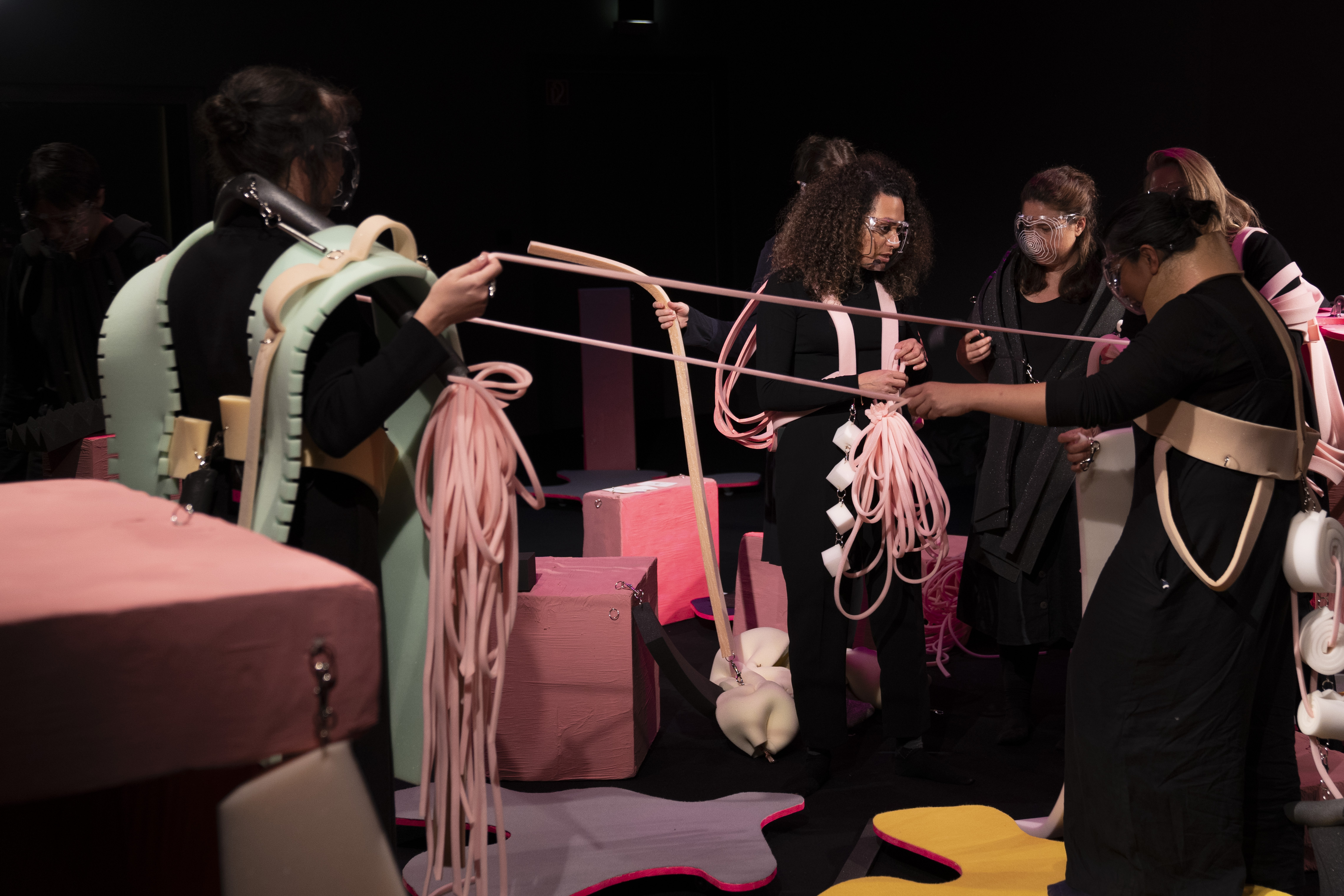
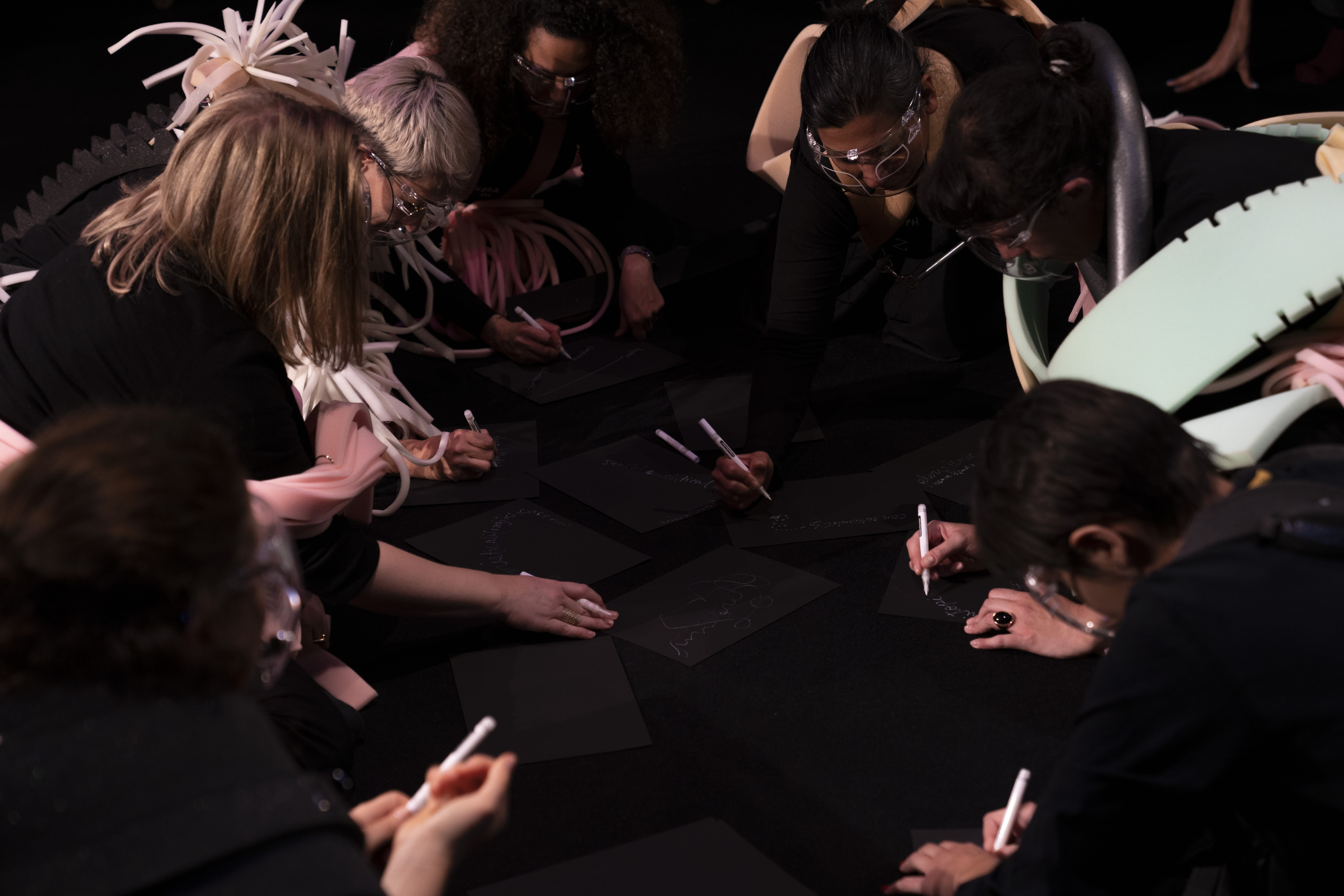
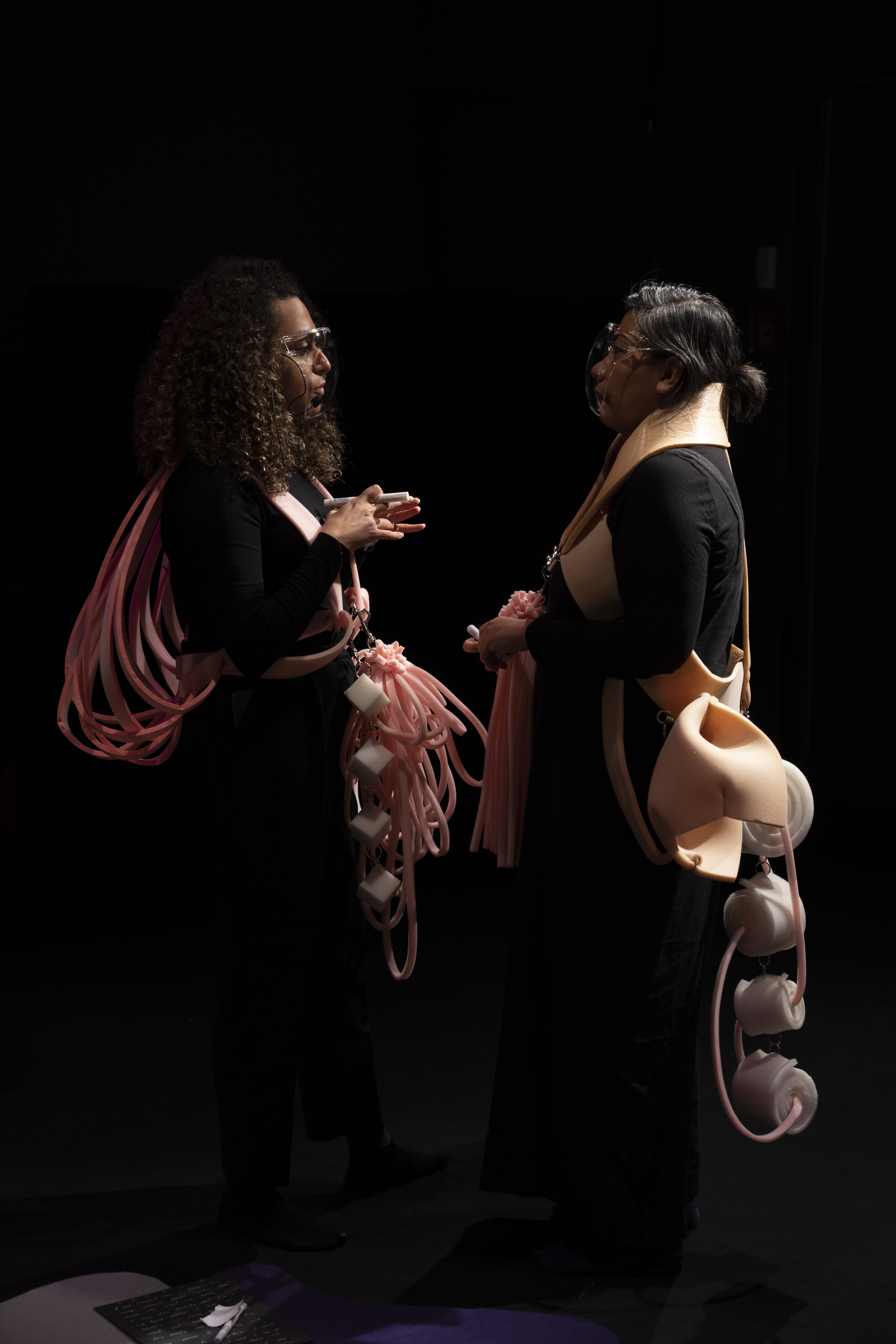

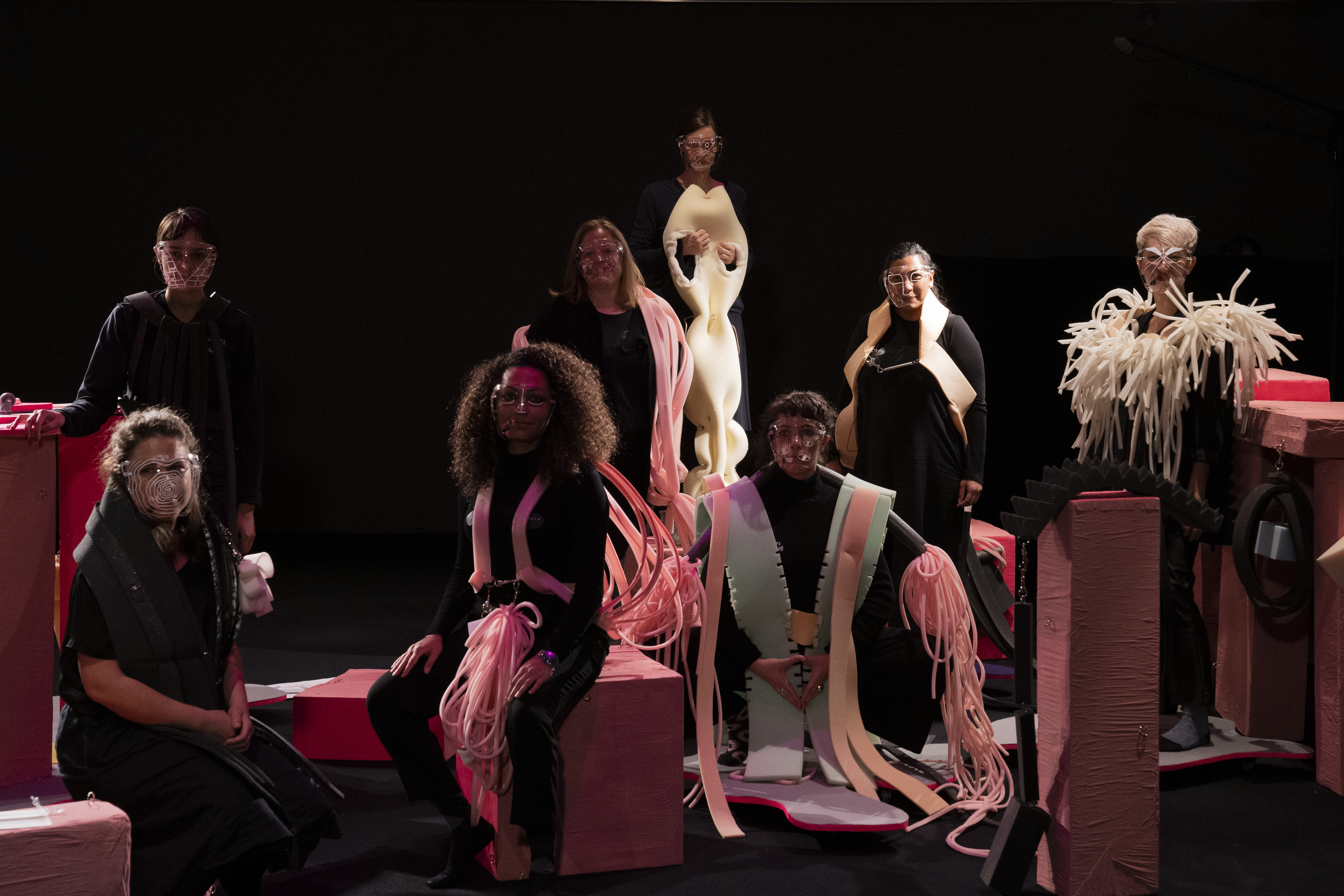
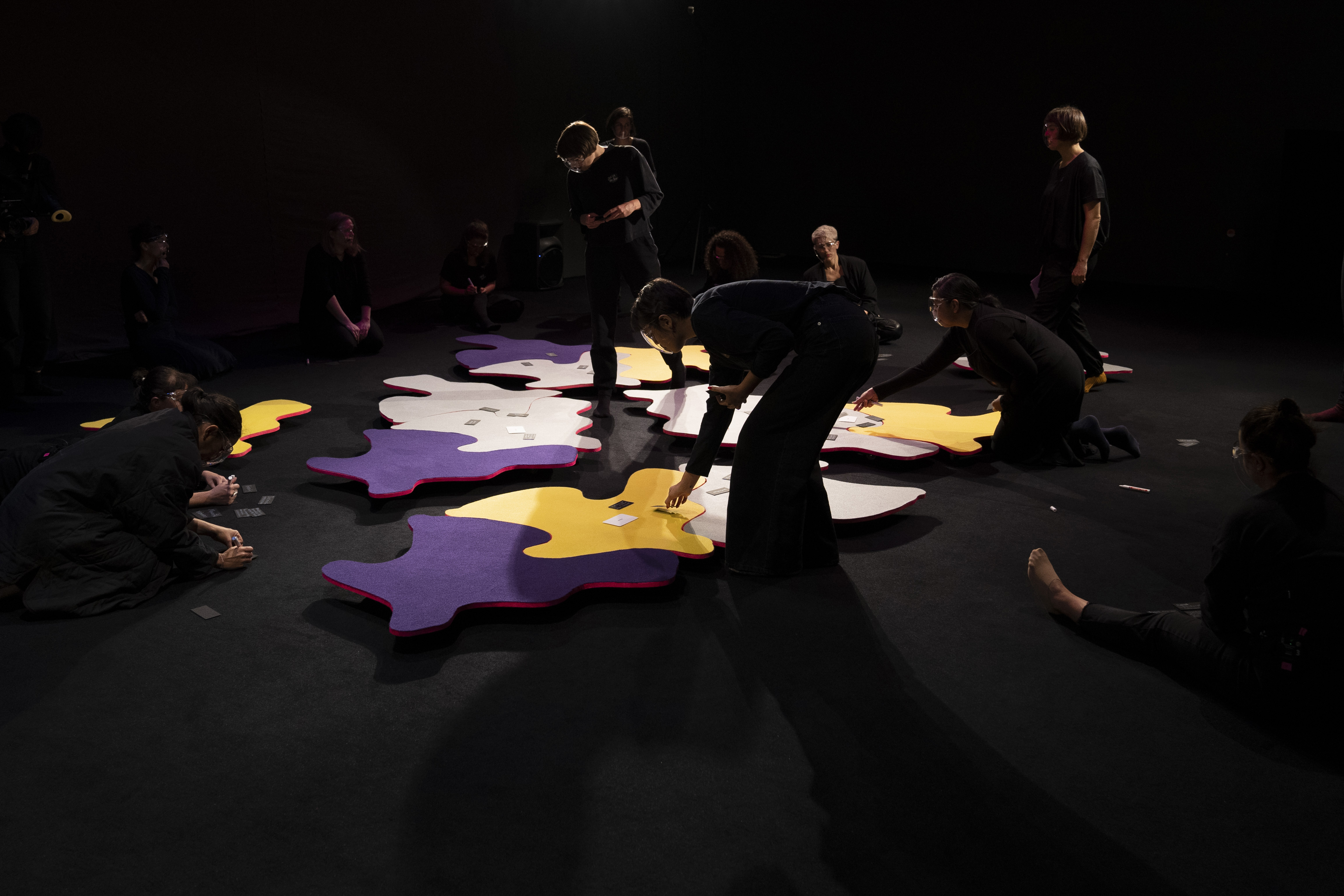
Ana de Almeida, Alicja Rogalskaand & Vanja Smiljanic
NOVA. Future thoughts on surviving together (2020 AT)
Live Action Role Play
In the future, gender inequality was erased. Nova is a multitude of newly born, radically inclusive and self-managed communities. Heterogeneous in their forms of commoning and social organization, Nova share a vow to never let oppression in any form rise again. Nova. Future thoughts on surviving together is a feminist futurist LARP - Live Action Role Play by Ana de Almeida, Alicja Rogalska and Vanja Smiljanić; directed towards feminist and queer-feminist activists based in Vienna. NOVA is a day of speculative gaming aimed at sharing survival strategies, exercising solidarity and intersectionality, creating solidarity networks and forming new alliances between different emancipatory movements. Together, we created a piece of feminist political fiction - a work in progress and a world free of patriarchal oppression in the making.
With: VBKÖ, Saloon Wien, Kunst & Kind, Latinxs Unidxs, Kültür Gemma, Cine Collective, Mala Sirena, female:pressure.


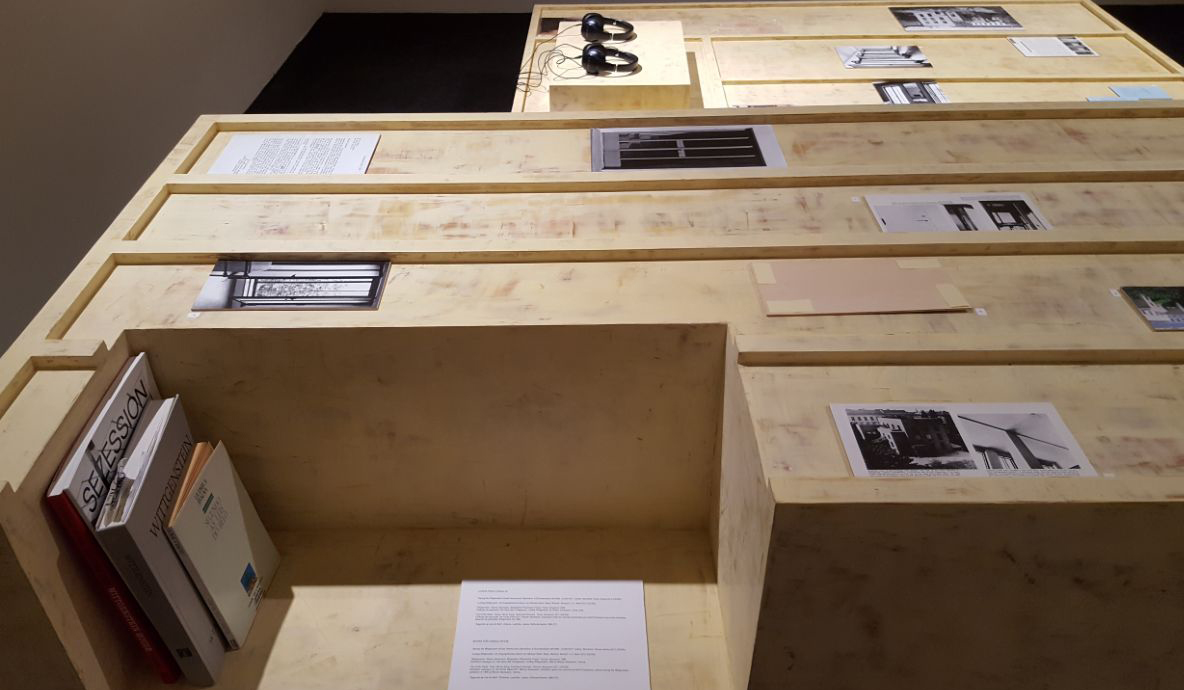
A Casa / The House The flat / Die Fläche (2018 PT)
MDF, stucco-lustro, stereo sound 42'5'' looped
Likewise a sculpture, A Casa (The House) shares the aesthetic and architectonic language of the House Wittgenstein in Vienna. The two volumes are a transposition and folding down of two of its architectonic elements: a window and the vestibule door. They serve as display for documental material such as letters and photos and incorporate an audio piece with interviews led by the artist. The surface is covered by stucco-lustro, a coating technique proliferating in Vienna on the turn to the 20th century, similar to how could the original coating of the walls of the House Wittgenstein have looked like before they were painted white after World War II. The highlighting of the stucco-lustro architectonic detail points out to a fundamental discovery for the understanding of the house as aesthetic experiment in which the house interiors, composed by materials which evoke extreme hardness, seem to dematerialize through the highly reflecting properties of the stucco walls.

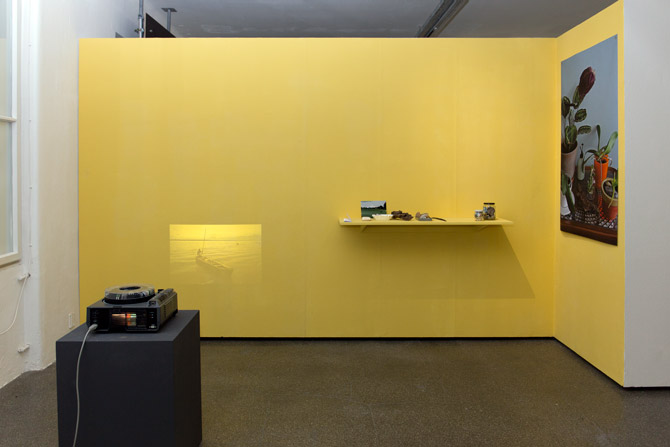
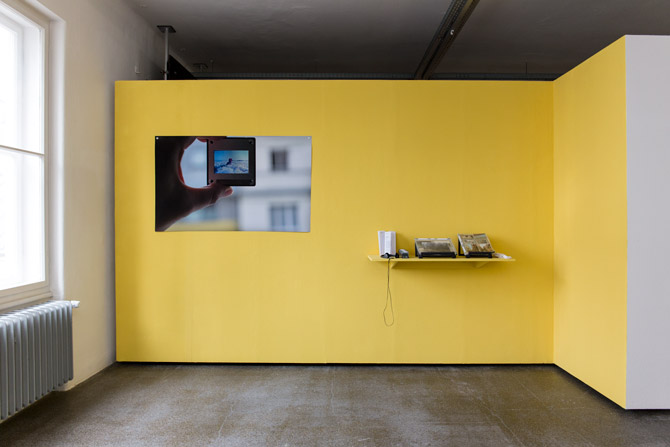
Photos: © Ana de Almeida & Stephanie Misa
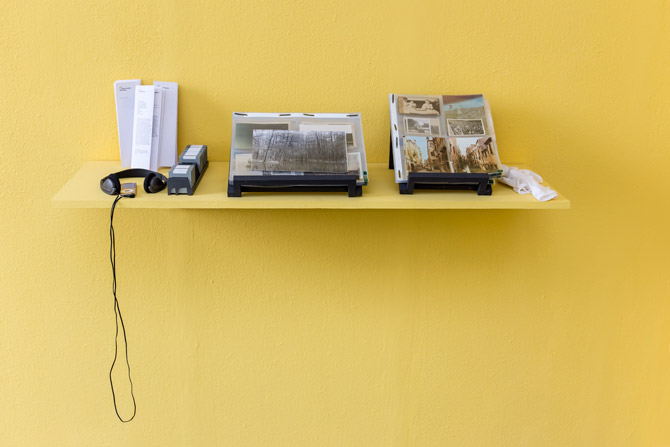
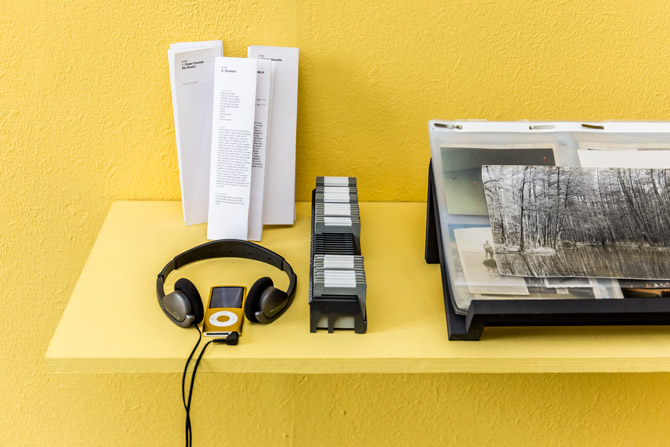
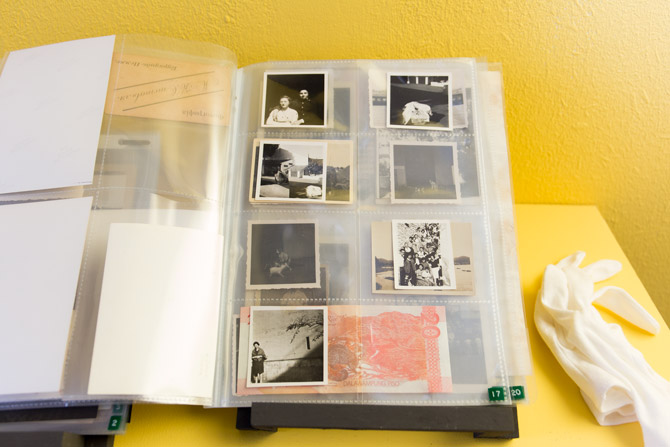
Untitled (Yellow) (2017 PT)
Wall, yellow paint, memorabilia, diashow, stereo sound
A cooperation between Ana de Almeida (PT/AT) and Stephanie Misa (PH/AT) . This is a project about landscape as formal and informal disposition of elements. Coordinates. An arrangement, a hierarchy: borders and de-limitations, transpositions and transgressions, frames and their inside-outside, margins, and of course landscape — of the geographical, political, personal, and emotional nature. Edouard Glissant’s Traité du Tout-Monde. (Poétique IV), calls it archipelagic thinking, a group of islands that lends its topography to an alternative imaginary: a reassessment of the insularity of bound cultures, of nation-states, and the heaviness of “continental thought”. The archipelago is an alternative imaginary, one that posits that identity could be as a conglomeration of islands (composed of many, yet is one). Identity formation, embodiment, complex colonial histories, evolution, interconnectedness, diaspora and change — Oh to dispell the oppressive idea of nationalistic wholeness!
JULIANA HERRERO
“cruce a nado el rio*
cruce
a nado
el mar”
#ARTS-BASED RESEARCH #DIGITAL #SOUND #PERCEPTION #PERFORMANCE #INSTALLATION
#ELECTRONICS
BIO. Juliana Herrero (b.1975, Choele Choel, AR) was educated in Argentina and Germany, developing later her work across the latitudes. Studies: 1986-1992 INSA -IUPA (dance and music), 1994-2000 UBA (architecture) AR; 2002-2006 Städelschule, School of Fine Arts, Ffm DE (arch. class -prof. Ben van Berkel, film class -prof. Mark Leckey). Currently she works between Vienna and Buenos Aires. In her pieces she contrasts sound spaces with visual impressions. She focuses on matters of perception addressing processes of change related to the ethereal environment and to social structures in the daily confrontation with technologies. For her, artistic resilience is a way to transform worlds.
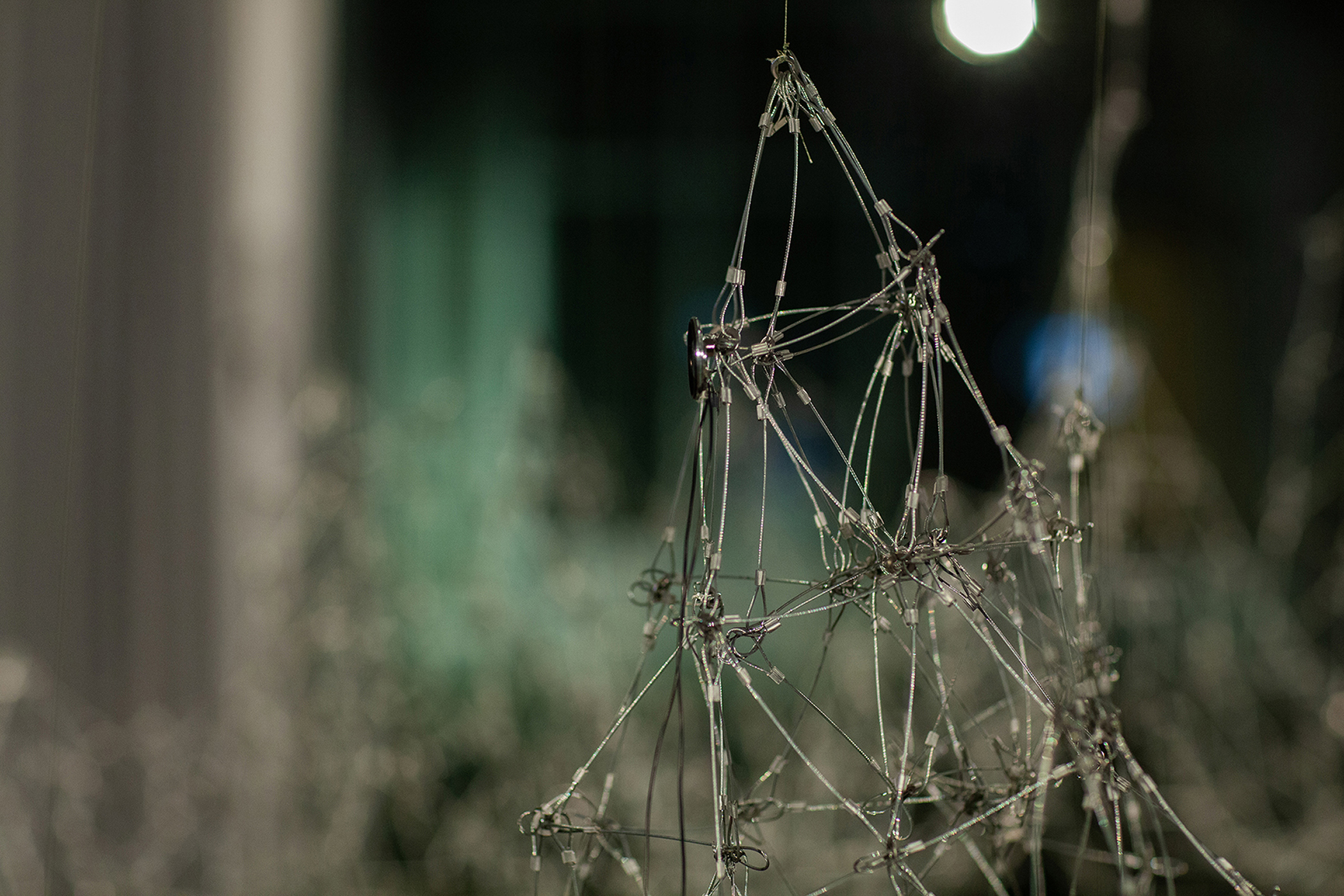
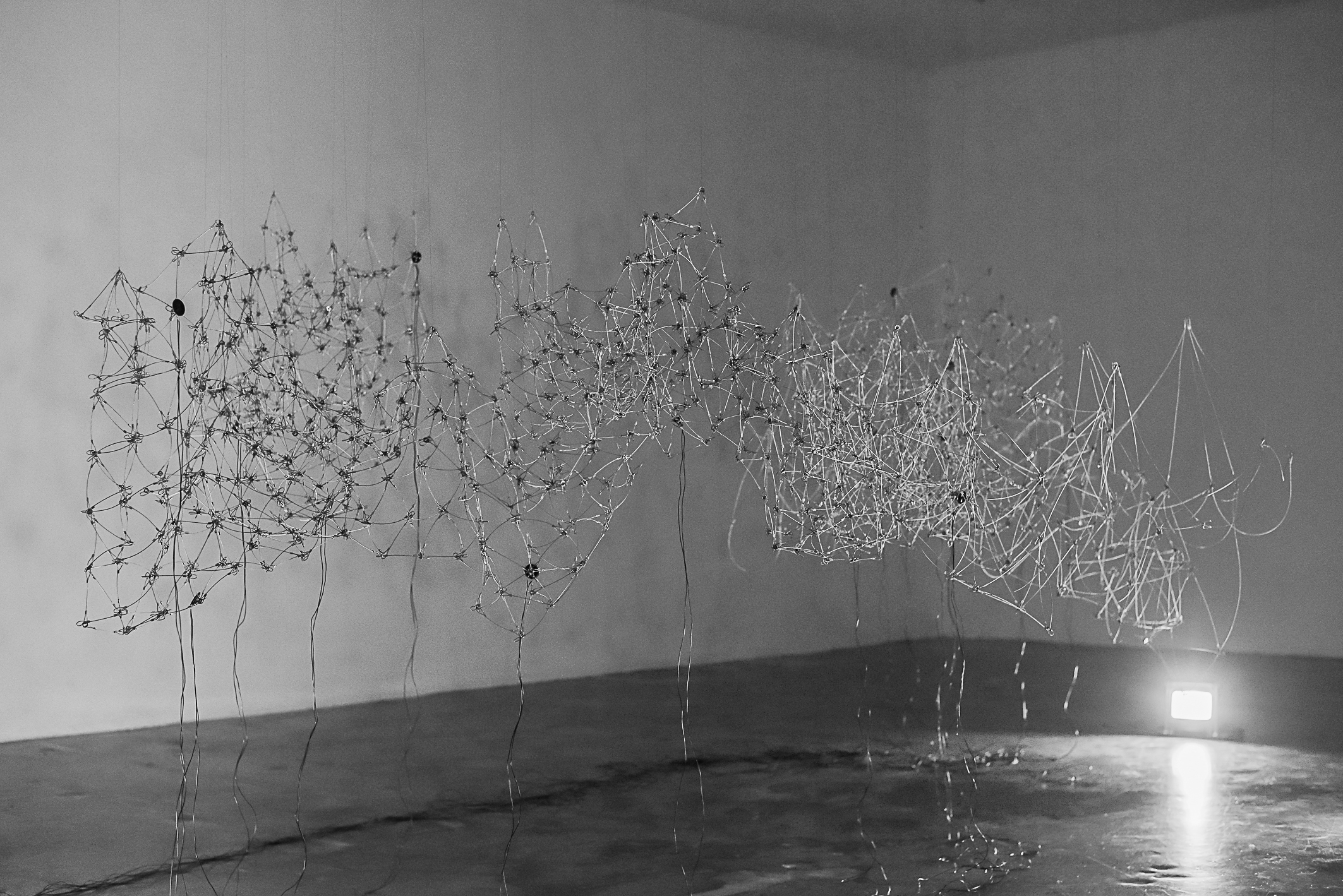
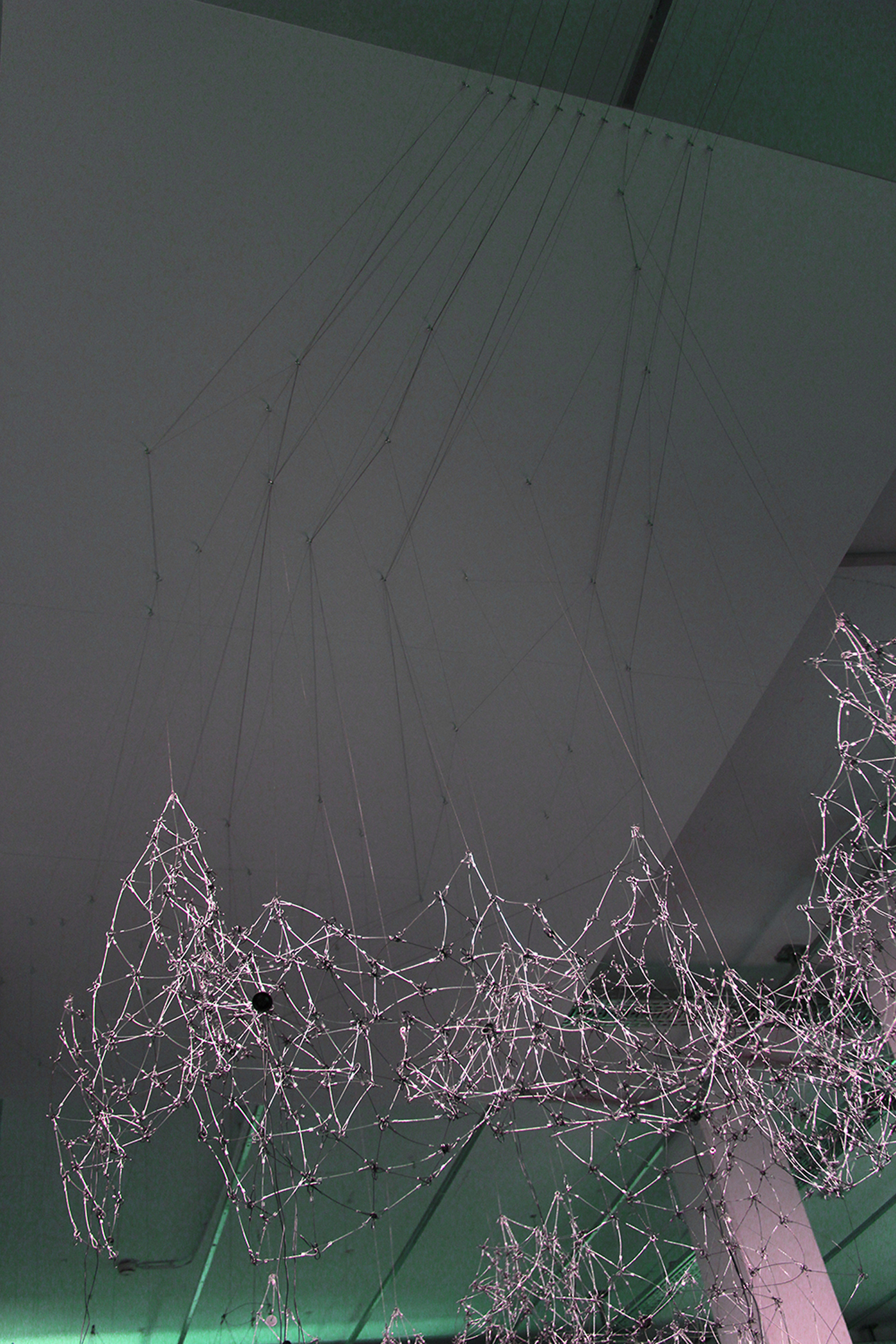

on the filaments, there where the plateau rises (2019)
Sound-kinetic installation
This piece attempts in an emancipatory way to investigate a meta- scape. Through the use of (digital) found footage and specially generated materials, which are fragmented and re-layered, fictional realities are created. Those emerge physically as filaments suspended in "latent" motion. The audio components of the work record location-based data such as geo-coordinates - in audio translation and relate them to each other through whispering and conversation. The sound of outer space, as how Earth is heard from the "Universe" (found footage internet -NASA) is also present. The voice(s) of the machine meet speech recordings to question phonetics and the rhythm of spoken language; the human voice, in contrast to the artificial-machine and the material, stands as a metaphor for the dialectical relationship between human being and technology, which is repeated in the affective perception and for processes of change in our real and imaginary cartographies.

Photos: © Eva Kelety Bildrecht
A White Noise, The Grilles And The Sea (2016)
Wall object with Sound
During consecutive summer night listening sessions performed by the artist at the sea side, a fine spectrum of the ethereal ecosystems was captured. This piece emerges as acoustic dissections and is reassembled on experimental cyanotypes as quasi-synesthetic frequencies accompanied by a micro-sound highlighting the chirping of the crickets. Here, Herrero juxtaposes sound to visual, exploring an aesthetic flow in which the imprints appear and disappear to describe a subjective experience of musicality. She looks at the subtle limits of inner and outer worlds and examines matters of perception moving at the edges of the public and private, inside and outside, analogue and digital, nature and artifact.

Photo: © Ingrid Cogne
From One Crystallon To The Pampia (2017)
Suspended installation over reflective board with tonal layer
This piece embodies as corpus one of the matrixes that made up the very first work belonging to the series of Sound Floating Landscapes, which was mute at first. It rewrites it as a specific elevated plateau registering the hidden coordinates in a plot and alluding to them as fixed points in space with little stones. It incorporates a tonal layer of crystalline sound aesthetics resulting from moment-by-moment dissections recorded during the process of weaving the wire-nets. The sound composition is abstract and based on the physics and acoustics of the materials relating to the work itself. It almost seems as if the small stones could resemble frozen drops transformed by the musicality of the material, crystallising in a collision. There is expressed the fleeting moment of an [imaginary] landscape in process of becoming. The title of the work refers to "Pampia" a micro continent that collides with the plate of the Rio de la Plata about 700 million years ago.