


ANA DE ALMEIDA
“Ficou
a ver
passar
navios.”
#ARTS-BASED RESEARCH #ARCHITECTURE #COMMONS #INSTALLATION #SPACE #MULTIMEDIA #IDENTITY #PERFORMANCE
#NEO-COLONIAL #VIDEO #GENDER
BIO. Ana de Almeida (b.1987) is an artist and author from Lisbon, currently based in Vienna. She is a member of the artists’
collective dienstag abendof
of VBKÖ and of the Interndinner collective against precarization of work in the cultural field. Her artistic practice addresses memory and remembering processes, narrative constructions that connect space and subject, and plurispatial and multilayered narratives in general.
Ana de Almeida is currently a Ph.D. candidate at the Academy of Fine Arts of Vienna, pursuing a doctoral thesis about the production of images in the 1974—1989 inter-revolutionary space between the Carnation and the Velvet Revolutions.
Ana de Almeida is currently a Ph.D. candidate at the Academy of Fine Arts of Vienna, pursuing a doctoral thesis about the production of images in the 1974—1989 inter-revolutionary space between the Carnation and the Velvet Revolutions.

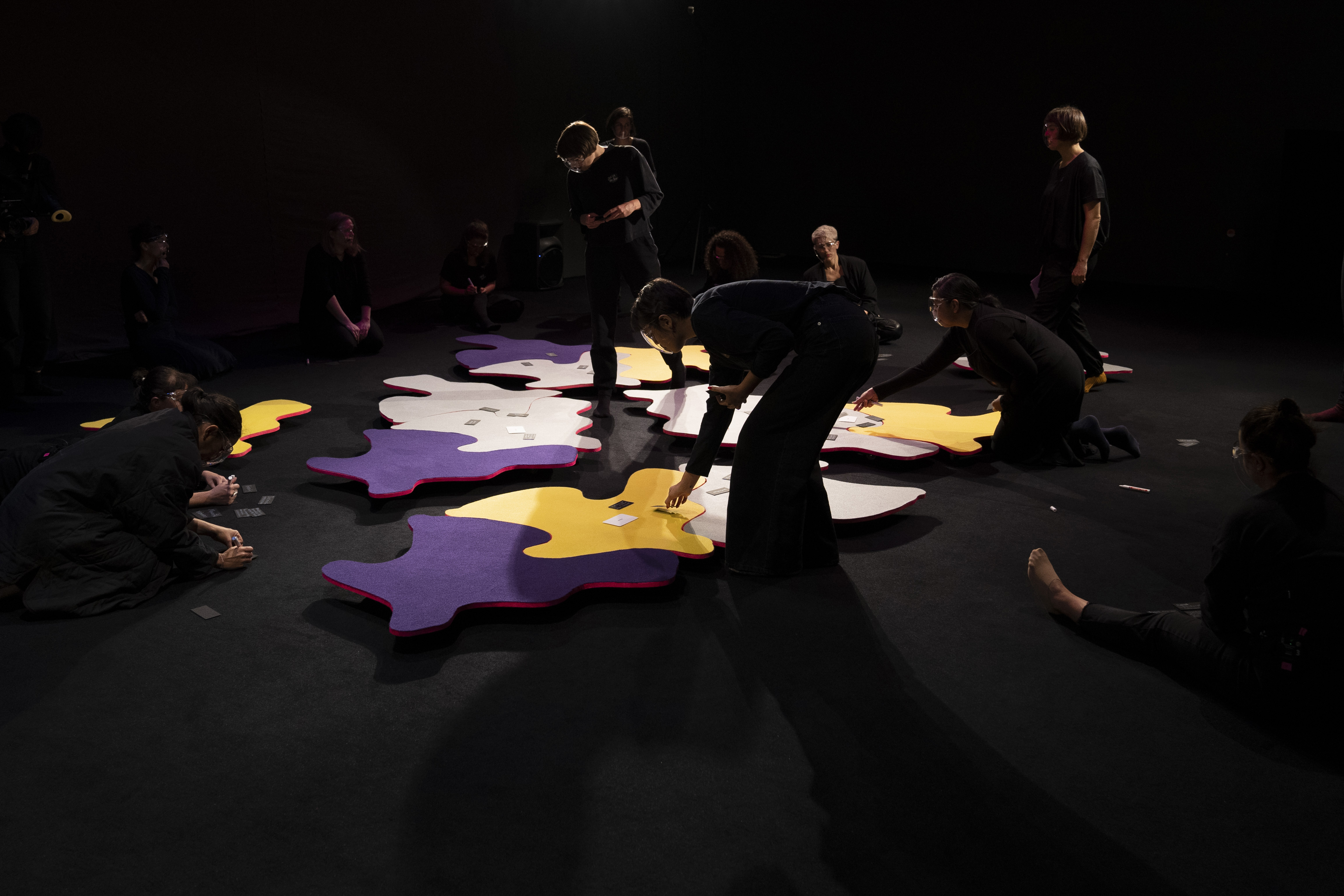
Ana de Almeida, Alicja Rogalskaand & Vanja Smiljanic
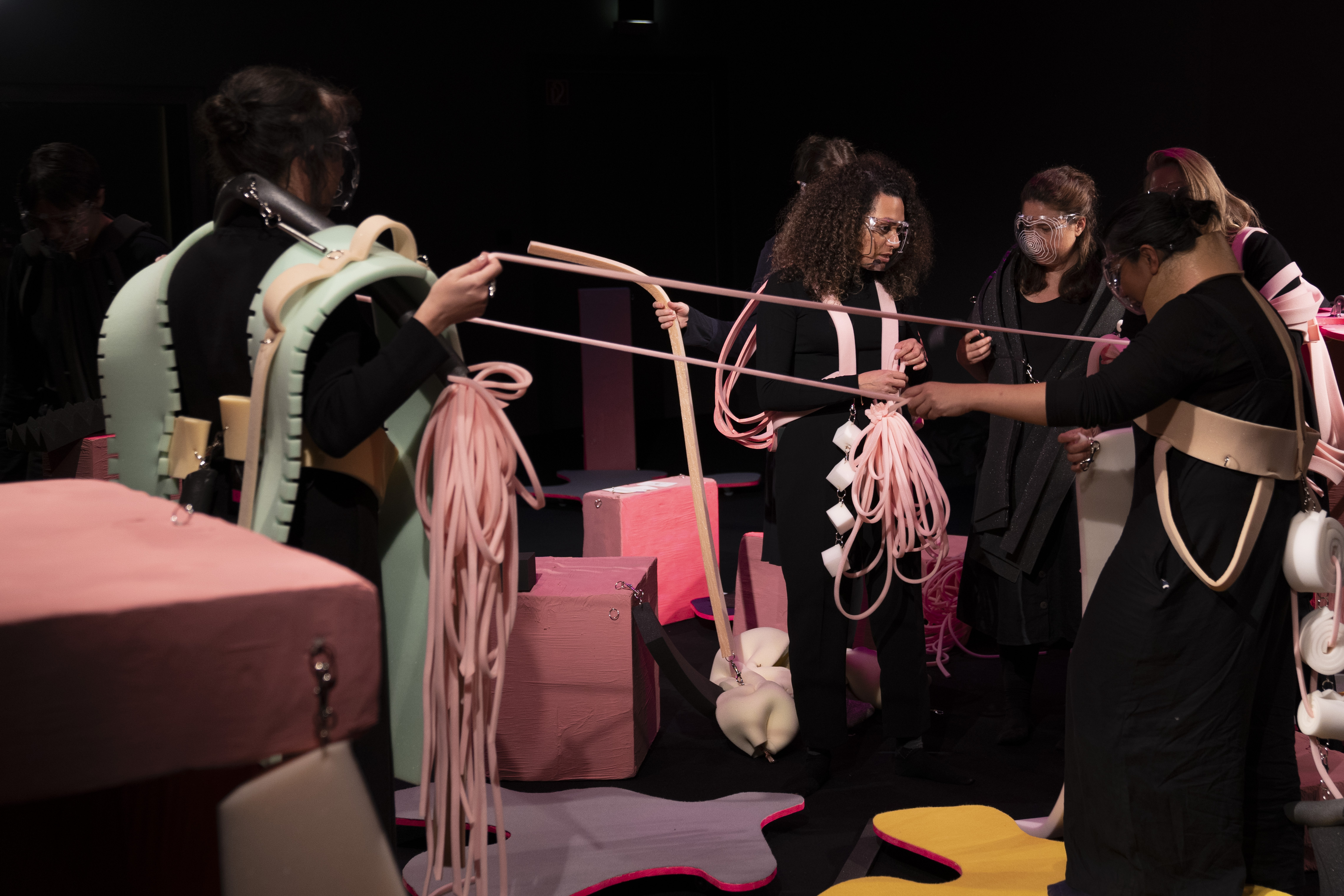
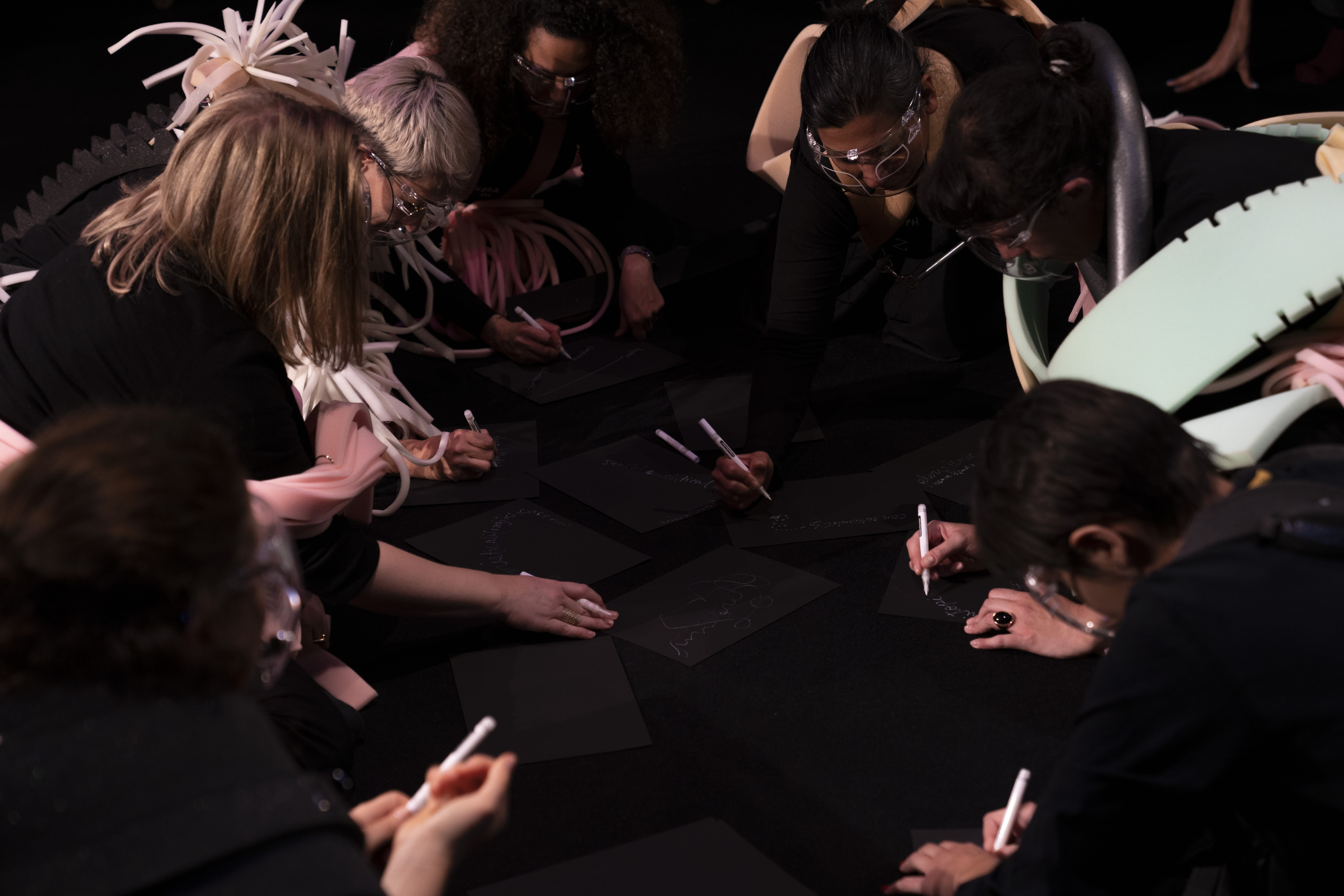
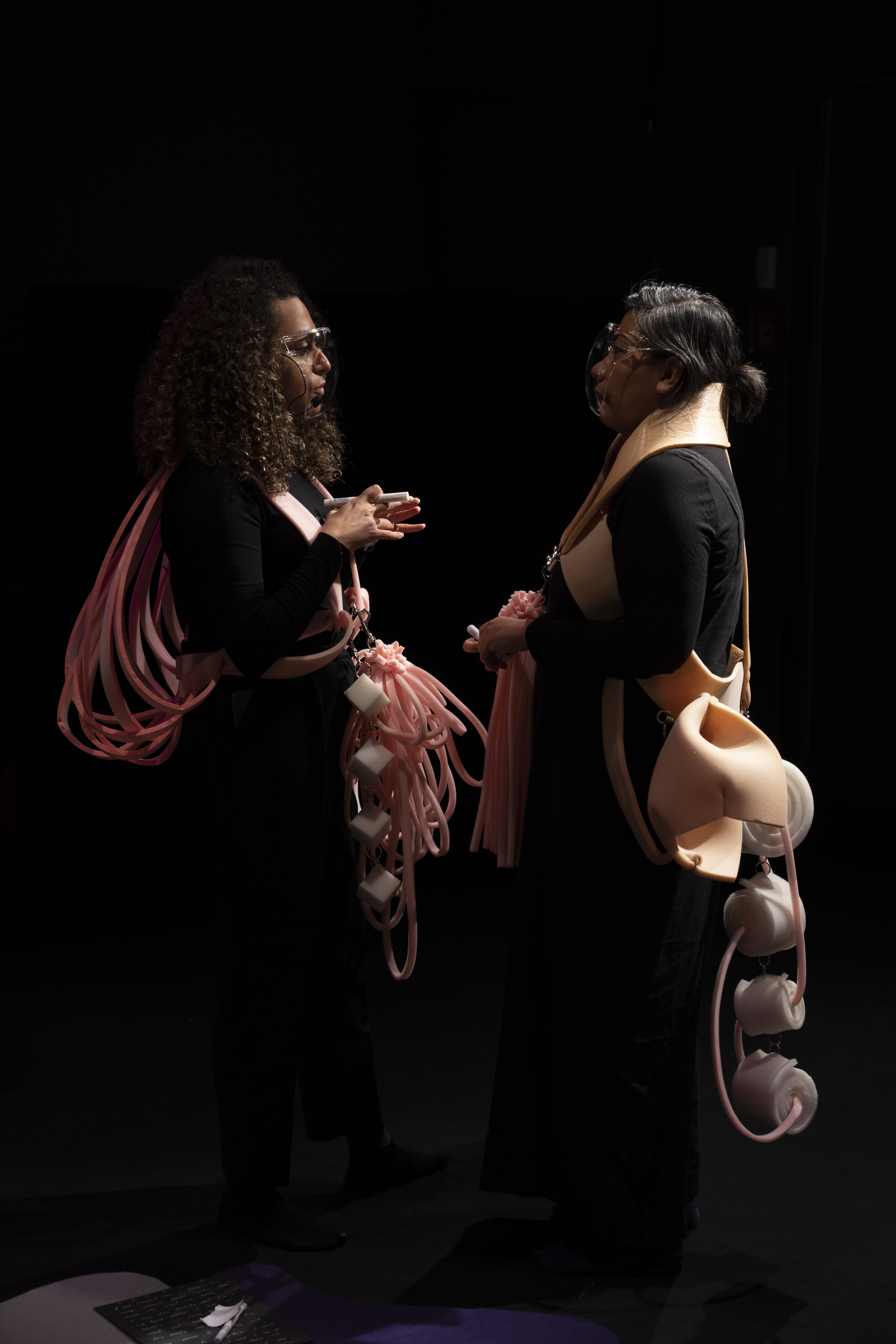
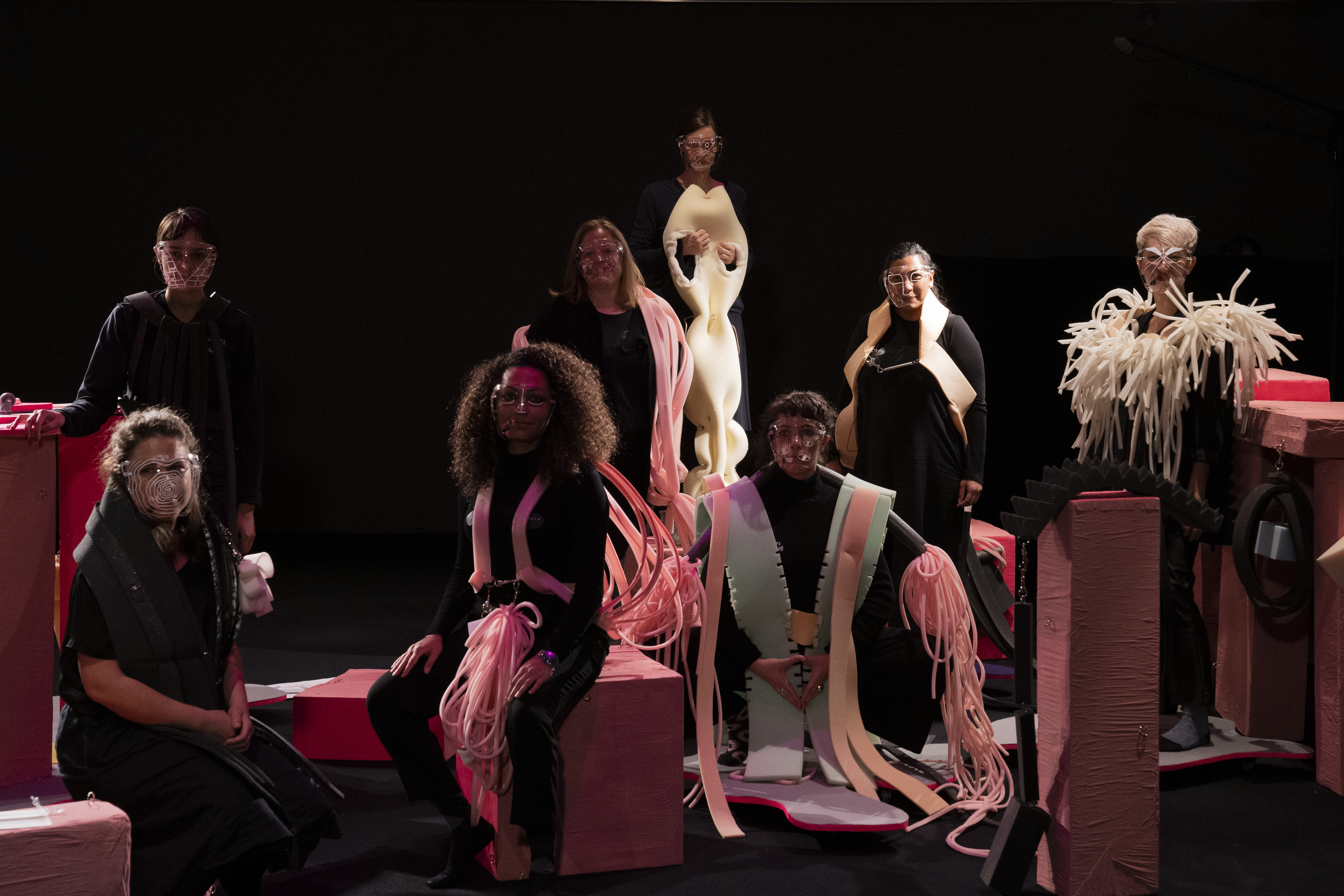
NOVA. Future thoughts on surviving together (2020 AT)
Live Action Role Play
In the future, gender inequality was erased. Nova is a multitude of newly born, radically inclusive and self-managed communities. Heterogeneous in their forms of commoning and social organization, Nova share a vow to never let oppression in any form rise again. Nova. Future thoughts on surviving together is a feminist futurist LARP - Live Action Role Play by Ana de Almeida, Alicja Rogalska and Vanja Smiljanić; directed towards feminist and queer-feminist activists based in Vienna. NOVA is a day of speculative gaming aimed at sharing survival strategies, exercising solidarity and intersectionality, creating solidarity networks and forming new alliances between different emancipatory movements. Together, we created a piece of feminist political fiction - a work in progress and a world free of patriarchal oppression in the making.
With: VBKÖ, Saloon Wien, Kunst & Kind, Latinxs Unidxs, Kültür Gemma, Cine Collective, Mala Sirena, female:pressure.


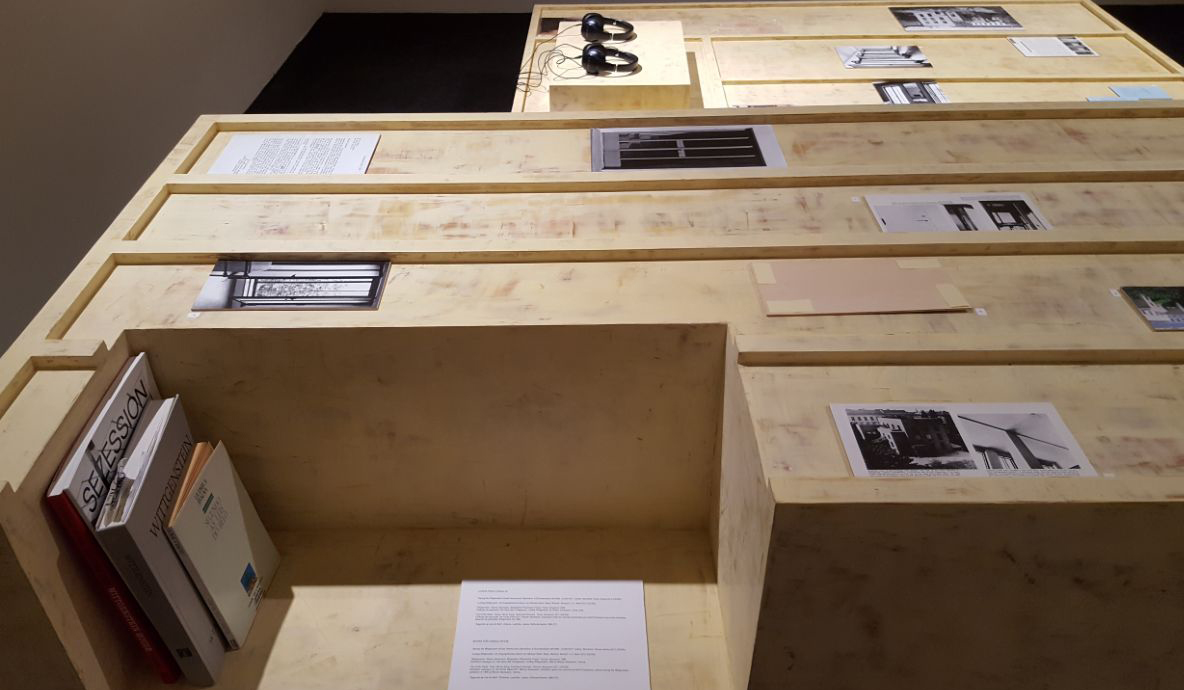
A Casa / The House The flat / Die Fläche (2018 PT)
MDF, stucco-lustro, stereo sound 42'5'' looped
Likewise a sculpture, A Casa (The House) shares the aesthetic and architectonic language of the House Wittgenstein in Vienna. The two volumes are a transposition and folding down of two of its architectonic elements: a window and the vestibule door. They serve as display for documental material such as letters and photos and incorporate an audio piece with interviews led by the artist. The surface is covered by stucco-lustro, a coating technique proliferating in Vienna on the turn to the 20th century, similar to how could the original coating of the walls of the House Wittgenstein have looked like before they were painted white after World War II. The highlighting of the stucco-lustro architectonic detail points out to a fundamental discovery for the understanding of the house as aesthetic experiment in which the house interiors, composed by materials which evoke extreme hardness, seem to dematerialize through the highly reflecting properties of the stucco walls.

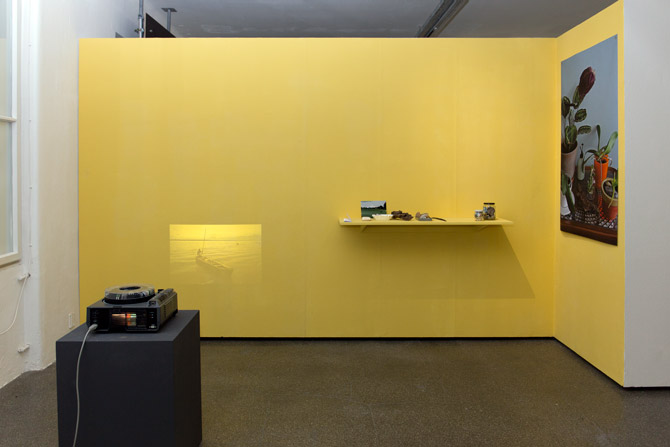
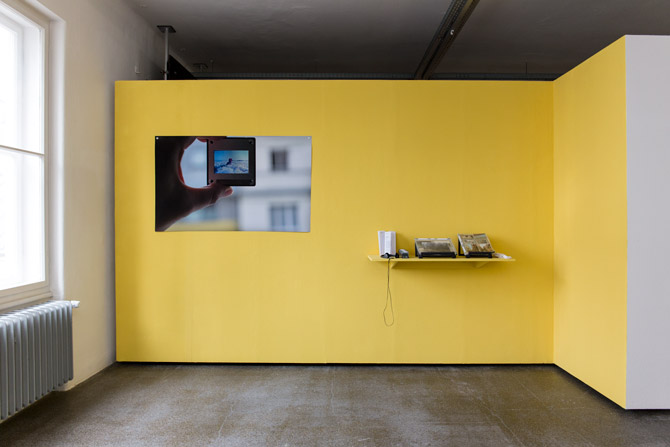
Photos: © Ana de Almeida & Stephanie Misa
Untitled (Yellow) (2017 PT)
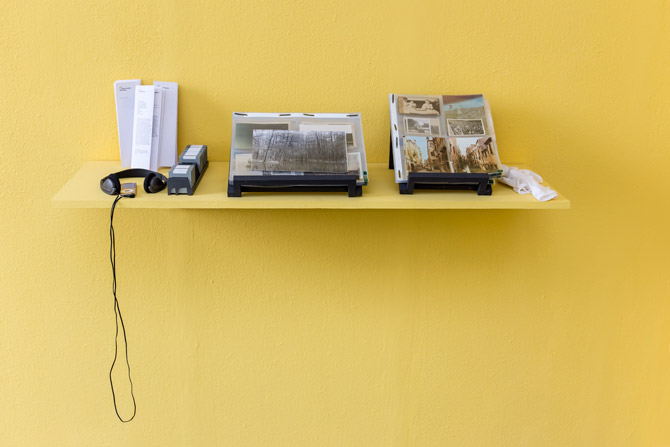
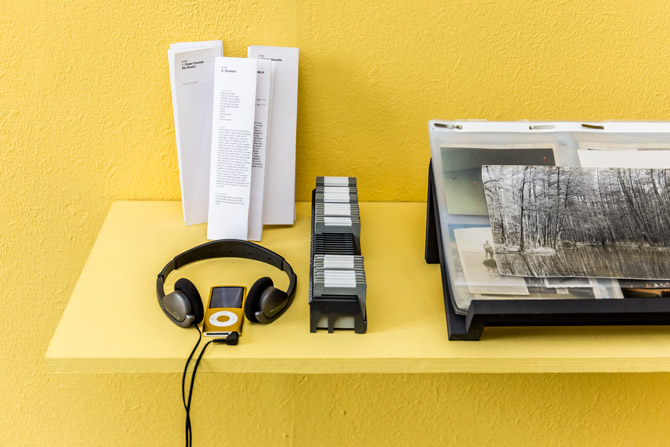
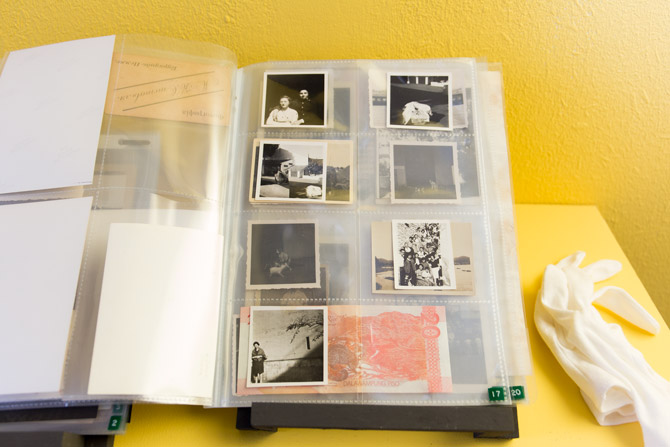
Wall, yellow paint, memorabilia, diashow, stereo sound
A cooperation between Ana de Almeida (PT/AT) and Stephanie Misa (PH/AT) . This is a project about landscape as formal and informal disposition of elements. Coordinates. An arrangement, a hierarchy: borders and de-limitations, transpositions and transgressions, frames and their inside-outside, margins, and of course landscape — of the geographical, political, personal, and emotional nature. Edouard Glissant’s Traité du Tout-Monde. (Poétique IV), calls it archipelagic thinking, a group of islands that lends its topography to an alternative imaginary: a reassessment of the insularity of bound cultures, of nation-states, and the heaviness of “continental thought”. The archipelago is an alternative imaginary, one that posits that identity could be as a conglomeration of islands (composed of many, yet is one). Identity formation, embodiment, complex colonial histories, evolution, interconnectedness, diaspora and change — Oh to dispell the oppressive idea of nationalistic wholeness!
PIPINA SCHICKANEDER
“Physics
is a special case
-art
![]()

is much more
than that.”
#ARTS-BASED RESEARCH #INSTALLATION #PERCEPTION #SCIENCE
BIO.
Gerburg Neunteufl Pipina Schickaneder *1976 in Graz, lives and works in Vienna. Master school for art in Graz, ao. Studied photography at the art universities in Vienna, diploma in mathematics and descriptive geometry at the Univ. and Vienna University of Technology. She uses her scientific background in geometry and especially colorimetry in her artistic work, in which she usually addresses the perception of scientific facts. Exhibitions include Galerie 12-14 and Galerie Westlicht (Vienna), Lindabrunn, Fotografie Forum (Frankfurt/Main), as well as in Munich, Graz, Istanbul, Bulgaria, Croatia, Poland.

Photo: © Flavio
Photons receives, photons responded
(2023) digital fotoprint on curtain
Two curtains hanging from the ceiling are parallel to each other, offer spaces in between and are the medium for images and image quotations of the associated photographic work. The complex science of photons is magnified and resolved here.
The objects that led to these photograms in the darkroom are nothing more than different lenses, mirrors and a glass prism, classic optical bodies. Pipina was inspired for this work by the new research results from ETH Zurich, which show that a new liquid fuel can be produced from light and air. In her artistic laboratory, she tried to track down this change in physical state, i.e. the transformation of light into a liquid.
 Image: © Pipina Schickaneder
Ansicht, Teil 3/ Views, Part 3 (2022)
Photogram b/w, photo emulsion on concreteThese two images show recreated representations of a magnetic resonance imaging of my lateral face. Instead of a scan, brush stripes of the photo emulsion and different development results of the exposed silhouettes on concrete can be seen. I have enlarged my internal facial image, created through modern medical imaging technology, onto stone tablets because I am interested in the juxtaposition to the physical and the history of representation. I examine in the series views different parts of the face and head with scientific digital theories, but analog and artistically applied. Different analytical methods, which are practiced with digital pictures and data collections, I confront my subjective picture logic and confront myself with my physical after-perceptions.

Images: © Pipina Schickaneder
Ansicht, Teil 1/ View, Part 1 (2018)
Color photograph (Laserprint on PC paper)
black/white photogram on PC paper
Each of these images can be understood both as preparations for and explorations of a self portrait. In the case of the color photograph, greyscale values are affixed to the area of the nose where they were measured. This transformation of subjective perception into seemingly objective data is reminiscent of the processes involved with digital facial recognition technology. During such a process of analytic acquisition, essential characteristics and contours disappear behind the massive amount of data collected. However, while this conversion renders one body part barely recognizable, another, the eyes, come more and more into focus. The personality and subjective viewpoint of the artist comes through clearly, in spite of the anonymising effect of the data points. In an additional transformative step, the measured greyscale values are presented in the form of a photogram. In a darkroom, a single sheet of photographic paper is exposed to various exposure lengths while being shielded under a complex system of layered paper cuttings. This results in a digital aesthetic resembling the analog process of digital imaging. These photographic works thus reveal not only the information loss inherent in the complexity of data analysis, but also call into question the borders dividing the analog and the digital.